
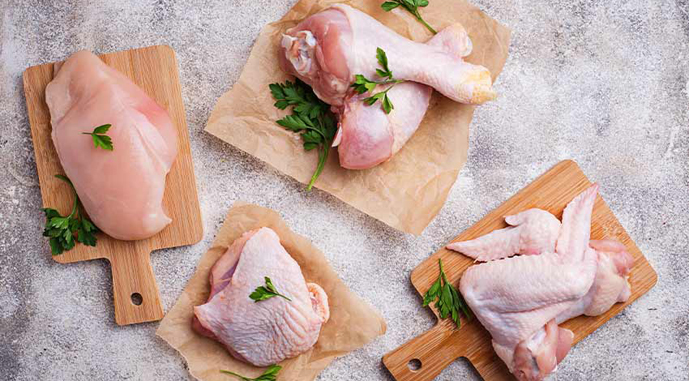
By 2027, the United Kingdom could come close to the entire European Union market in terms of its purchases of Ukrainian chicken meat, while the importance of Middle Eastern countries for Ukrainian exporters will decline, according to a forecast by the Kyiv office of the U.S. Department of Agriculture (USDA FAS).
In the “Poultry and Products Annual” report, published on August 19, 2026, the United Kingdom is identified as one of the key drivers of growth in Ukrainian chicken meat production and exports in 2026–2027.
On January 16, 2026, Ukraine and the United Kingdom agreed to extend duty-free trade in chicken meat and a number of other agricultural products through March 31, 2028. The United Kingdom will not impose a tariff quota on Ukrainian chicken until that date.
According to USDA estimates, this effectively provides Ukrainian producers with nearly two additional years of unrestricted access to one of the world’s most price-competitive markets. In some months, retail prices for Ukrainian chicken in the United Kingdom have even been higher than in the EU.
As a result, FAS/Kyiv expects a further sharp increase in shipments to the United Kingdom. By 2027, their volume could become comparable to Ukraine’s total chicken exports to the EU.
At the same time, the European Union remains the industry’s largest premium market; however, shipments are limited by a new permanent duty-free quota of 120,000 metric tons per year.
The new quota was agreed upon by Ukraine and the EU in October 2025. It replaced the pre-war permanent quota of 90,000 metric tons and the temporary regime of autonomous trade measures, which allowed for significantly larger volumes to be shipped. The USDA expects that in 2026–2027, actual exports to the EU will remain at the established limit of 120,000 metric tons.
The expansion of shipments to the United Kingdom and the EU is already changing the geography of Ukrainian exports.
A shift is particularly noticeable in the Middle East. The USDA reports that in 2026, shipments of Ukrainian chicken to Saudi Arabia—which had previously been Ukraine’s largest single export market for this product—ceased entirely.
This occurred despite MHP’s long-standing relationship with Saudi Arabia and the Saudi Agricultural and Livestock Investment Company (SALIC), which owns 13% of MHP. However, the USDA acknowledges the possibility of Ukrainian products returning to the Saudi market in the coming years.
Exports to Iraq, on the other hand, continue. The USDA specifically notes that Ukraine was not included in the ban on chicken imports imposed by Iraq on 39 major supplier countries due to the risks of highly pathogenic avian influenza.
Ukrainian producers also maintain a presence in the markets of Africa and the former Soviet Union countries; however, the most profitable European markets are gradually drawing a portion of the production toward them.
Exports via Turkey are primarily transit-based: according to USDA industry sources, most of the Ukrainian poultry arriving there is subsequently re-exported to Asia or Africa. At the same time, the free trade agreement between Ukraine and Turkey, which will take effect in 2026, provides for a separate duty-free quota of 2,000 metric tons of raw and processed poultry products.
Overall, according to the latest estimate by FAS/Kyiv, chicken meat exports from Ukraine will increase from about 450,000 metric tons in 2025 to 490,000 metric tons in 2026 and 530,000 metric tons in 2027.
Thus, one of the key changes over the next two years will be the further reorientation of the Ukrainian poultry industry toward the United Kingdom and the EU, at the expense of some of its traditional markets in the Middle East and Asia.
Original source: USDA Foreign Agricultural Service, Ukraine: Poultry and Products Annual, UP2026-0022, August 19, 2026.
Last modified: August 25, 2026









 Аналітичні дослідження у сфері макроекономіки, політології, футурології з використанням передових науково-технічних досягнень та методів. Створення відеоконтенту, надалі – документального контенту. Проведення конференцій, консалтинг, розвиток дискусійних майданчиків.