
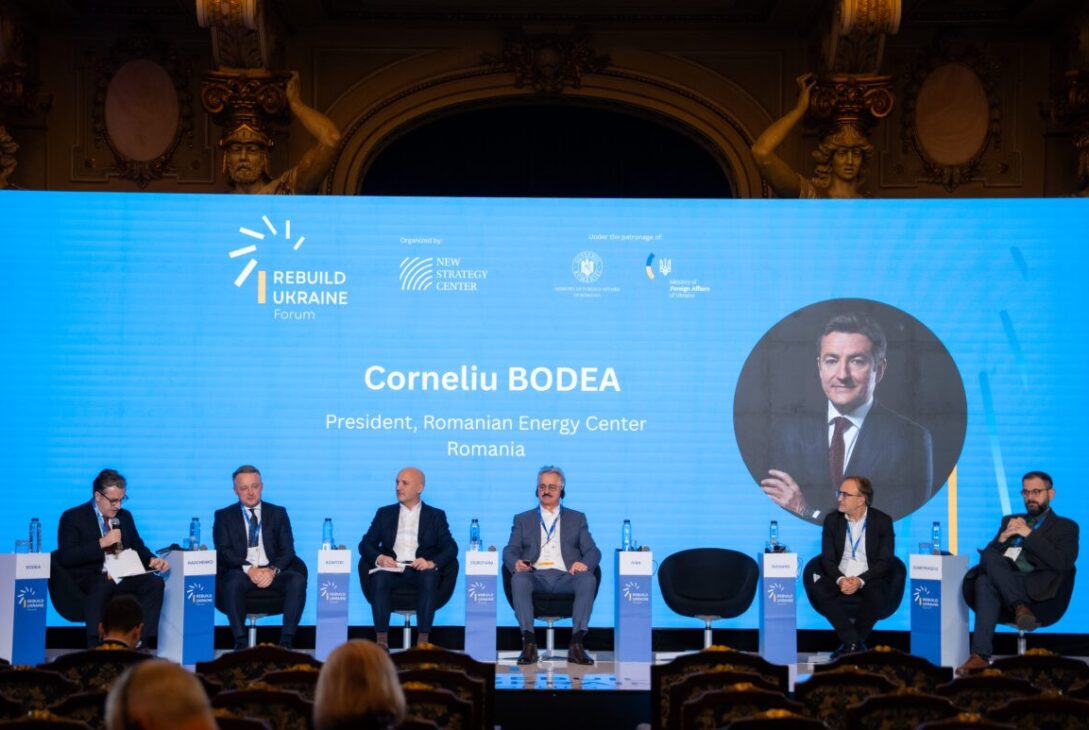
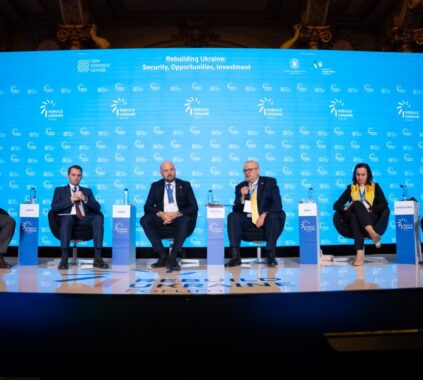
Participants in the Green Reconstruction and Green Energy panel at the Rebuilding Ukraine: Security, Opportunities, Investments forum in the Romanian capital concluded that the modernization and decarbonization of Ukraine’s energy infrastructure must go hand in hand with digitalization, the development of smart cities, and deeper integration into the EU energy space.
The panel was moderated by Corneliu Bodea, president of the Romanian Energy Center, who outlined the need for profound transformations of energy systems to transition to a low-carbon model. The key speaker was Bogdan-Gruia Ivan, Romania’s Minister of Energy, who set the strategic guidelines for the discussion. The discussion was also joined by George Agafitei, Head of Sustainable Development and Institutional Relations at PPC Group; Vitaly Radchenko, Head of Energy and Climate Change Practice at CMS Ukraine; Nicolas Richard, CEO of Engie Romania; Gheorghe Chubotar, President of Electroalfa International; and Eduard Dumitrascu, President of the Romanian Smart City Association.
The speakers noted that urban digitalization and energy modernization projects, in particular smart city initiatives, have become important catalysts for the renewal of local energy systems and municipal infrastructure. They emphasized that Ukraine should not be underestimated in terms of technological solutions: businesses and government agencies are highly receptive to the implementation of digital tools, from artificial intelligence to network infrastructure optimization. “Ukraine has already demonstrated its ability to quickly transition to new digital platforms. This makes it possible to build a modern energy sector rather than a ‘patched-up’ one,” Radchenko noted.
Participants emphasized that Ukraine is undergoing an intensive phase of legislative reforms and convergence with European standards in the fields of energy, ecology, and market regulation. This creates conditions for more effective coordination between central authorities and local levels, as well as for the implementation of joint projects with EU countries, with an emphasis on inter-state interconnectors, network balancing, and strengthening regional energy security. “Aligning rules with European ones is not only a requirement for integration, but also a prerequisite for attracting investors to long-term ‘green’ projects,” Ivan emphasized.
A separate part of the discussion was devoted to rethinking the architecture of energy networks in the direction of decentralization, flexibility, and increasing opportunities for electricity flows between countries. Participants recalled that Ukraine is already working in sync with the European energy system and is increasing the volume of electricity and gas exchanges with EU countries. In their opinion, Ukraine’s “green” transformation requires not only the physical reconstruction of generation and network assets, but also the formation of a new culture of innovation capable of attracting strategic investments and the most advanced technologies.
In this context, cooperation between European and Ukrainian energy and technology ecosystems was described as a fundamental element of regional energy sustainability. Participants called green reconstruction a historic opportunity to form a more sustainable, digitized, and EU-integrated Ukrainian economy. The panel concluded that, despite the challenges, close cooperation and coordinated investment by the state, business, and international partners is the only realistic path to an effective, future-oriented reconstruction of the energy sector.
The forum “Rebuilding Ukraine: Security, Opportunities, Investments” is being held on December 11-12 in Bucharest under the auspices of the Romanian Ministry of Foreign Affairs and the Ukrainian Ministry of Foreign Affairs and is organized by the New Strategy Center. According to the organizers, more than 30 panel discussions and parallel sessions are planned over two days with the participation of representatives of governments, international organizations, the private sector, financial institutions, and experts from Europe, North America, and Asia. The topics of the panels cover security and defense, infrastructure, financing and investment, green energy, digitalization, human capital, and cross-border cooperation.
digitalization energy market EU integration reconstruction
Last modified: December 12, 2025







 Аналітичні дослідження у сфері макроекономіки, політології, футурології з використанням передових науково-технічних досягнень та методів. Створення відеоконтенту, надалі – документального контенту. Проведення конференцій, консалтинг, розвиток дискусійних майданчиків.