
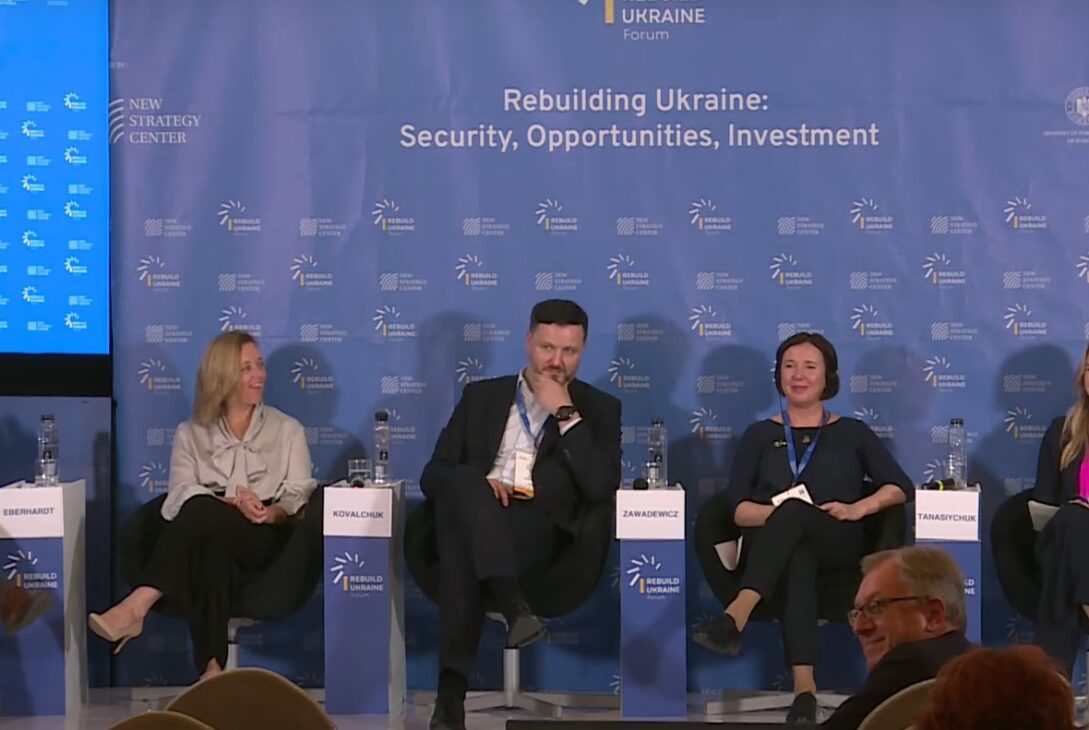
Participants in the panel discussion “Challenges of the Ukrainian Labor Market. Mobilizing Human Capital for Sustainable Reconstruction” at the forum on Ukraine’s reconstruction in Bucharest concluded that the country needs a two-pronged policy for sustainable economic recovery: creating conditions for the return of those who wish to do so, while simultaneously supporting the active diaspora as a resource for investment and knowledge transfer.
The panel was moderated by Adam Eberhart, Deputy Director of the Center for East European Studies at the University of Warsaw (SEW UW). The discussion was joined by Svitlana Kovalchuk, Executive Director of the Yalta European Strategy (YES) Bogdan Zavadetchik, President of the Charitable Foundation “Resources and Public Initiatives” in the Chernivtsi region Olena Tanasychuk, representative of the Ukrainian diaspora in the UK at Ealing Community & Voluntary Service (ECVS) Ania Abdulah, and Osamu Hattori, Head of the Japan International Cooperation Agency (JICA) office in Ukraine.
According to surveys cited by participants, most Ukrainian refugees would only consider returning if there were reliable guarantees of security and a stable economic situation. At the same time, statistics show that after two to three years abroad, the likelihood of returning decreases sharply due to deeper integration of people into their host countries, particularly through employment, children’s education, and access to social services. “The longer people stay abroad, the more their lives shift—and the harder it is to convince them to start from scratch at home,” Ebergart noted.
Separately, experts noted that the potential opening of borders could trigger a new wave of emigration, particularly among men of conscription age, who are currently restricted from leaving due to mobilization rules. Against this backdrop, participants emphasized the need for policies that, on the one hand, create the conditions for return—through security, jobs, housing, and access to services—and, on the other hand, support a strong and organized diaspora.
The discussion concluded that the Ukrainian diaspora can remain an important resource for the country’s development even without physical return, through investment, professional networks, educational and expert projects. “The question is not only how many people will return, but also how many of them, wherever they live, will remain actors in Ukraine’s development,” Kovalchuk concluded. Participants agreed that a coordinated human capital policy should be one of the key elements of Ukraine’s post-war reconstruction strategy.
The forum “Rebuilding Ukraine: Security, Opportunities, Investments” is being held on December 11-12 in Bucharest under the auspices of the Romanian Ministry of Foreign Affairs and the Ukrainian Ministry of Foreign Affairs and is organized by the New Strategy Center. According to the organizers, more than 30 panel discussions and parallel sessions are planned over two days with the participation of representatives of governments, international organizations, the private sector, financial institutions, and experts from Europe, North America, and Asia. The topics of the panels cover security and defense, infrastructure, financing and investment, green energy, digitalization, human capital, and cross-border cooperation.
Bucharest reconstruction of Ukraine refugees діаспора
Last modified: December 12, 2025






 Аналітичні дослідження у сфері макроекономіки, політології, футурології з використанням передових науково-технічних досягнень та методів. Створення відеоконтенту, надалі – документального контенту. Проведення конференцій, консалтинг, розвиток дискусійних майданчиків.