
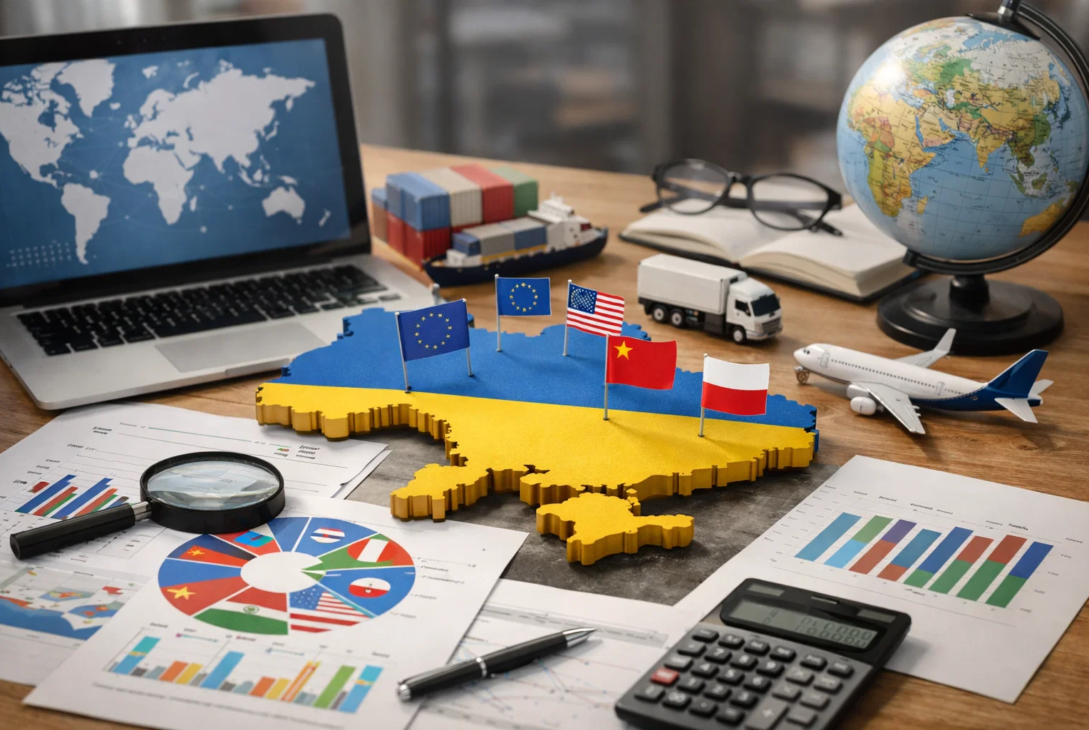
Statistical data on Ukraine’s top 50 trading partners as of the end of 2025 show a high concentration of trade, a significant import bias, and several markets where Ukraine already has a stable advantage — these should be scaled up without ignoring logistical and regulatory risks.
| Top 50 countries by volume of trade in goods with Ukraine as of December 31, 2025. | |||||
| No. | Country | Imports | Exports | Balance | Volume |
| 1 | China | 19226823 | 1817726 | -17409097 | 21044549 |
| 2 | Poland | 7957124 | 5063631 | -2893493 | 13020755 |
| 3 | Germany | 6621021 | 2442141 | -4178880 | 9063162 |
| 4 | Turkey | 6216470 | 2733347 | -3483123 | 8949817 |
| 5 | United States | 4633333 | 1059648 | -3573685 | 5692981 |
| 6 | Italy | 2736906 | 2288034 | -448872 | 5024940 |
| 7 | Czech Republic | 2412340 | 996925 | -1415415 | 3409265 |
| 8 | Romania | 1900743 | 1407248 | -493495 | 3307991 |
| 9 | Hungary | 2026030 | 1278809 | -747221 | 3304839 |
| 10 | Slovakia | 2244328 | 1029176 | -1215152 | 3273504 |
| 11 | Netherlands | 1085863 | 1921591 | 835728 | 3007454 |
| 12 | Bulgaria | 1939054 | 1048205 | -890849 | 2987259 |
| 13 | France | 2143218 | 783641 | -1359577 | 2926859 |
| 14 | Spain | 1064386 | 1732107 | 667721 | 2796493 |
| 15 | India | 1757877 | 857955 | -899922 | 2615832 |
| 16 | Lithuania | 1461993 | 709839 | -752154 | 2171832 |
| 17 | United Kingdom | 1433796 | 648357 | -785439 | 2082153 |
| 18 | Greece | 1522775 | 392699 | -1130076 | 1915474 |
| 19 | Egypt | 296958 | 1521918 | 1224960 | 1818876 |
| 20 | Austria | 765006 | 564295 | -200711 | 1329301 |
| 21 | Moldova | 160331 | 1160462 | 1000131 | 1320793 |
| 22 | Belgium | 705782 | 580896 | -124886 | 1286678 |
| 23 | Vietnam | 934118 | 227378 | -706740 | 1161496 |
| 24 | Korea | 952524 | 182901 | -769623 | 1135425 |
| 25 | Sweden | 1043981 | 81556 | -962425 | 1125537 |
| 26 | Japan | 1086086 | 32880 | -1053206 | 1118966 |
| 27 | Switzerland | 887367 | 107303 | -780064 | 994670 |
| 28 | Algeria | 135171 | 627738 | 492567 | 762909 |
| 29 | Israel | 401186 | 313496 | -87690 | 714682 |
| 30 | Denmark | 451859 | 220080 | -231779 | 671939 |
| 31 | Taiwan, Province of China | 629253 | 21569 | -607684 | 650822 |
| 32 | Indonesia | 256628 | 321694 | 65066 | 578322 |
| 33 | Lebanon | 3293 | 529655 | 526362 | 532948 |
| 34 | Saudi Arabia | 197662 | 333157 | 135495 | 530819 |
| 35 | Latvia | 220944 | 301729 | 80785 | 522673 |
| 36 | Azerbaijan | 277917 | 233246 | -44671 | 511163 |
| 37 | Norway | 466583 | 35891 | -430692 | 502474 |
| 38 | United Arab Emirates | 121275 | 335401 | 214126 | 456676 |
| 39 | Malaysia | 346982 | 107069 | -239913 | 454051 |
| 40 | Serbia | 268531 | 175608 | -92923 | 444139 |
| 41 | Canada | 278070 | 138126 | -139944 | 416196 |
| 42 | Kazakhstan | 77444 | 322735 | 245291 | 400179 |
| 43 | Finland | 343203 | 49727 | -293476 | 392930 |
| 44 | Iraq | 323 | 392513 | 392190 | 392836 |
| 45 | Georgia | 96259 | 290403 | 194144 | 386662 |
| 46 | Slovenia | 287220 | 81437 | -205783 | 368657 |
| 47 | Thailand | 309508 | 58875 | -250633 | 368383 |
| 48 | Bangladesh | 191377 | 164469 | -26908 | 355846 |
| 49 | Mexico | 307351 | 42614 | -264737 | 349965 |
| 50 | Brazil | 264546 | 71054 | -193492 | 335600 |
The table of the top 50 countries in terms of trade in goods with Ukraine as of December 31, 2025, reveals three basic features of the 2025 model. First, the market is highly concentrated, with the top ten countries accounting for about two-thirds of the total volume, and China alone accounting for almost one-fifth. Second, imports dominate, with total imports in the TOP 50 sample significantly exceeding exports, resulting in a significant negative balance. Third, despite the overall deficit, there is a group of countries with a positive balance where Ukraine has either a competitive commodity niche (agricultural products/food) or a profitable channel of access to broader markets (trade hubs).
“The overall picture is consistent with the aggregate statistics for 2025: Ukraine’s imports are estimated at about $84.8 billion, exports at about $40.3 billion, and trade turnover at about $125.1 billion,” emphasizes Maxim Urakin, founder of the Experts Club information and analytical center.

The five largest partners and their roles in Ukraine’s balance of trade
China is the undisputed leader in terms of volume: $21.04 billion (imports $19.23 billion, exports $1.82 billion, balance −$17.41 billion). This is a classic example of an “industrial goods supplier” partnership, which in the context of war and reconstruction is becoming even more asymmetrical: Ukraine needs machinery, equipment, electrical engineering, components, and consumer goods faster than it is able to increase exports with high added value. The summary results for 2025 confirm that the largest commodity groups of imports are machinery, equipment, transport, chemicals, and fuel and energy products.
There will be no “quick” solutions with China to balance the trade deficit without increasing Ukraine’s industrial export positions. A realistic focus is the localization of part of the supply chains for Ukrainian needs (components for energy, transport, and reconstruction), contract manufacturing, and the expansion of agricultural and food exports with deeper processing where it is economically justified by logistics and access conditions,” notes Maksym Urakyn.
Poland ranks second among our trading partners with a total trade volume of $13.02 billion in 2025 (imports of $7.96 billion, exports of $5.06 billion, and a balance of $2.89 billion). This country performs two functions simultaneously: it is a large bilateral market and a key land “corridor” to the EU (including logistics, hubs, and redistribution of flows). Poland will account for the largest share of Ukrainian exports by value in 2025 (approximately $5 billion).
“The risk factor here is not so much economic as regulatory and political, because agricultural trade with the EU and certain neighbors after 2022 has become a sensitive issue, and the issue of quotas/restrictions periodically returns to the agenda, which directly affects Ukraine’s most massive export nomenclature,” emphasized the founder of Experts Club.
Thus, in order to optimize trade with Poland, it is critical to increase the share of “less conflictual” items (processing, industrial components, reconstruction goods), in parallel with long-term coordination of rules for access to agricultural markets within the framework of the updated Ukraine-EU trade regimes.
Germany ranks third in terms of trade volume with $9.06 billion (imports of $6.62 billion, exports of $2.44 billion, and a balance of $4.18 billion). It is primarily a supplier of high-tech industrial products, machinery, and infrastructure goods, which creates a significant structural deficit. At the same time, Germany remains one of the key destinations for Ukrainian exports (approximately $2.4 billion in 2025), meaning that the channel works both ways, but asymmetrically.
“The growth potential here is directly linked to the prospects for post-war reconstruction, when demand for Ukrainian materials, semi-finished products, and agricultural processing may increase, but the decisive factor will be the “quality of entry” — standards, traceability, certification, and integration into European value chains, where the EU will simultaneously support Ukrainian production with exports of machinery and equipment,” Maxim Urakhin emphasized.
Turkey has secured fourth place among our trading partners with a total trade volume of $8.95 billion ($6.22 billion in imports, $2.73 billion in exports, and a balance of $3.48 billion). This is the most “promising” partner among the top 5 in terms of institutional accelerator: in February 2026, the Ukrainian government announced the approval of a draft Free Trade Agreement with Turkey, which provides, in particular, for 0% Turkish customs duties on 10,337 commodity items (95% of Ukrainian exports by number of items) and better access for processed agricultural products, as well as the complete abolition of customs duties on industrial goods by Turkey.
Thus, Turkey has the potential to become a “southern window” for Ukrainian exports with high scaling potential, especially if the agreement comes into full effect. This does not guarantee automatic balance of payments equalization, but it significantly reduces barriers to export growth and product diversification.
The US ranks fifth among trading partners with $5.69 billion (imports $4.63 billion, exports $1.06 billion, balance − $3.57 billion). The American direction in 2025 looks like “technological and capital-intensive” because Ukraine imports significantly more than it exports, which partly reflects the structure of demand in the military economy (equipment, specific goods, components), while exports to the US remain relatively small. The overall structure of Ukraine’s imports in 2025 also highlights the dominance of machinery/equipment and energy carriers among the major categories.
“Growth here is possible due to niche goods with high added value (IT-embedded products, engineering services with ‘landing’ in commodity supplies, certain food and processed agricultural items), but the key condition will be stable logistics and compliance with US market requirements,” Urakin clarifies.
Where to look for growth: countries with a positive balance and markets that can scale quickly
A separate category is countries where Ukraine already has a positive balance. Among them, Egypt stands out (approximately +$1.23 billion). This indicator is not accidental, as it reflects Ukraine’s role as one of the key suppliers of grain to North African markets. Open sources record an increase in the presence of Ukrainian wheat on the Egyptian grain market in 2025, as well as the high sensitivity of this channel to the security of Black Sea ports and logistics costs.
“In the long term, if Ukraine maintains its maritime corridor and reduces logistics costs, Egypt and the wider North African region could see rapid growth in ‘bulk’ items, as well as additional potential in processed agricultural products and oils, where demand is supported by a shortage of local raw materials,” the economist adds.
The second type of prospect is EU trade hubs, where a positive balance (as in the Netherlands) often means that the country acts as a gateway to the wider European market. The EU remains Ukraine’s main trading partner, but the access regime, especially in the agricultural segment, is evolving towards more “managed” parameters, with quotas and safeguards for sensitive goods and broader liberalization for less sensitive goods. At the same time, Ukraine will have obligations to bring its standards closer to European ones and will have to compete with local agricultural producers.
“Such a focus on hubs, primarily the Netherlands and, to some extent, Spain, makes sense only if exporters agree to shift the nomenclature from ‘politically sensitive’ raw goods to processing and stable items such as vegetable oils. The dynamics of oil imports into the EU show that Ukraine maintains a strong position in this segment,” Urakin emphasized.
The third direction is the closest neighbors and the strengthening of regional ties, where growth is ensured not so much by customs duties as by the “physical” capacity of borders and transportation rules. A telling case is Moldova, with a balance of about +$1.0 billion. In 2025, Ukraine and Moldova continued the liberalization of road transport (“transport visa-free regime”), and government communications directly link this to trade growth (+12% per year).
Anything that reduces transaction costs at the border (digital procedures, capacity, “visa-free” transport) has a disproportionately large effect on regional markets, and this is one of the fastest ways to increase trade turnover without complex industrial investments.
Therefore, Ukraine’s trade growth potential in 2026 will be determined by three “levers” that can already be identified. The first is the conditions of access to EU markets, which are our largest market, but with more structured rules in the agricultural sector and a strong emphasis on standards. The second is institutional agreements with regional partners, where the example of Turkey looks like a potential leap forward in reducing barriers. The third is logistics and maritime security, as this determines the competitiveness of Ukraine’s “mass” export categories (grain, ore/metals, oils) and the stability of contracts with countries such as Egypt.
Ultimately, the top five partners in 2025 demonstrate the diversity of their economic roles, with China as the main source of imports, Poland and Germany as key European channels with industrial and logistical content, Turkey as a “southern window” with strong potential for mutually beneficial expansion, and the US is a strategic security direction with commodity asymmetry.
“The most applicable ‘growth points’ for Ukraine are a combination of markets with an already positive balance (Egypt, Moldova, and, to some extent, EU trade hubs) and tools that reduce barriers: agreements, standardization, and logistics,” Maxim Urakhin concluded.
Last modified: February 28, 2026






 Аналітичні дослідження у сфері макроекономіки, політології, футурології з використанням передових науково-технічних досягнень та методів. Створення відеоконтенту, надалі – документального контенту. Проведення конференцій, консалтинг, розвиток дискусійних майданчиків.