
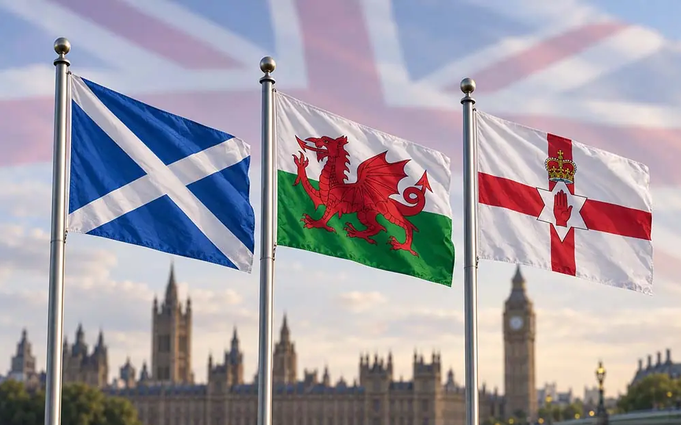
According to Experts.news, the leaders of the ruling nationalist parties in Scotland, Wales, and Northern Ireland signed a memorandum of cooperation in Cardiff on September 14, which affirms the right of their peoples to determine their own constitutional future and calls on the UK government to prepare for possible constitutional changes.
The document was signed by John Swinney, leader of the Scottish National Party (SNP) and First Minister of Scotland; Rhun ap Iorwerth, leader of Plaid Cymru and First Minister of Wales; and Michelle O’Neill, vice president of Sinn Féin and First Minister of Northern Ireland. Sinn Féin President Mary Lou McDonald also participated in the meeting.
However, the participants acted as leaders of their respective parties, not on behalf of the governments of Scotland, Wales, and Northern Ireland. This is particularly important in the case of Northern Ireland, where power is shared between Sinn Féin and the Democratic Unionist Party (DUP). Deputy First Minister Emma Little-Pengelly of the DUP stated that O’Neill does not have the authority to sign such documents on behalf of the Northern Ireland government.
The memorandum’s main political call was for the British government to “prepare for, plan, and facilitate constitutional changes in Wales, Scotland, and Northern Ireland.” The parties also reaffirmed the right of each of the three nations to determine their own future through democratic means.
However, the wording of the memorandum, as published by British media, does not contain the expected tougher demand for immediate referendums on secession from the United Kingdom. The focus is primarily on recognizing the principle of self-determination, establishing mechanisms for future constitutional changes, and ensuring that London does not block the democratic choice if sufficient support emerges within the regions themselves.
Sweeney stated that the United Kingdom is at a “turning point in constitutional change” and that the residents of each of the three territories must have the opportunity to determine their own future. Earlier, on September 10, he appealed to British Prime Minister Andy Bernam with a proposal to create a legal mechanism that would allow for a new referendum on Scottish independence if there were a sufficient public mandate.
On August 28, the Scottish government published a draft of a new referendum bill featuring the same question used in 2014: “Should Scotland be an independent country?” The bill is scheduled to be introduced in Parliament after receiving the necessary authorization from Westminster.
In Northern Ireland, the legal situation is different. The possibility of holding a vote on unification with Ireland is already provided for in the 1998 Belfast Agreement. The decision to call such a referendum is made by the British Secretary of State for Northern Ireland if he or she considers it likely that a majority of residents would support unification.
In Wales, there is no permanent legal mechanism for holding a referendum on independence. At the same time, the current Plaid Cymru government considers independence to be the ultimate goal, although Rhyn ap Iorwerth emphasizes that there is no specific timeline for such a vote yet and that the decision must depend on the position of the Welsh people themselves.
In addition to constitutional issues, the meeting participants agreed to expand cooperation in the economy, energy, relations with the European Union, and international politics. Nationalist parties believe that following Brexit and shifts in the political balance within the United Kingdom, Scotland, Wales, and Northern Ireland now share more common interests in their relations with London.
The summit was the first event of its kind since the 2026 elections, when nationalist and pro-self-determination parties simultaneously took the helm of the governments in Scotland, Wales, and Northern Ireland. However, the signed document does not yet have legal force and does not automatically trigger any referendum.
Great Britain Northern Ireland Scotland Wales референдум
Last modified: September 14, 2026





 Аналітичні дослідження у сфері макроекономіки, політології, футурології з використанням передових науково-технічних досягнень та методів. Створення відеоконтенту, надалі – документального контенту. Проведення конференцій, консалтинг, розвиток дискусійних майданчиків.